

VLBI Products
|
GSI has been performing international VLBI observations for geodesy at the Ishioka Geodetic Observing Station since 2015. This page provides analysis results of VLBI observations.
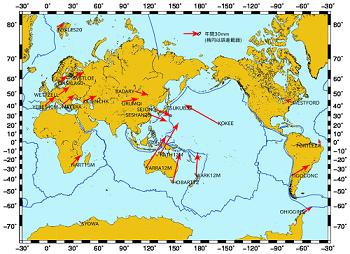
The average motion of VLBI stations, which reflects the motion of the tectonic plates on which they are located, can be determined from data obtained through VLBI observations over several years. The red arrows on the map above show relative magnitude and direction of movement over one year.

Locations of the observation stations GSI monitors changes in baseline length between Ishioka/Tsukuba station and other VLBI stations around the world.
Please tap "click here" in the table below to view the corresponding graph of the baseline length. For the baselines with data from before the 2011 earthquake, off the Pacific coast of Tohoku, you can see the steady changes in baseline length caused by tectonic plate motion before the earthquake, as well as the large changes due to the earthquake and subsequent unsteady crustal movements.
*The baseline length between Tsukuba and each observation station is converted to the baseline length between Ishioka and each observation station based on the parallel observation results of Tsukuba and the Ishioka Station. 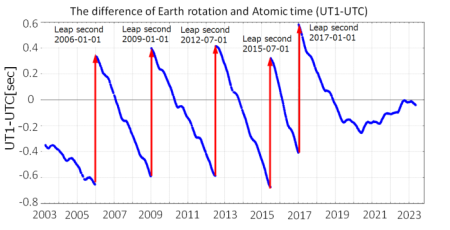
VLBI measures the difference between time based on the Earth’s rotation (Universal Time: UT1) and time based on precise atomic clocks (Coordinated Universal Time: UTC).
The large jump in the graph indicates that a leap second had been inserted. Since the Earth's rotation speed changes continuously and is difficult to predict accurately, continuous monitoring is essential. UT1-UTC is analyzed using the analysis software c5++, which was jointly developed by Hitotsubashi University, NICT, and JAXA.  Some files are available in PDF format. To view PDF files, Adobe System's free "Adobe Reader" software must be installed. Please visit the following link to download the free software. |